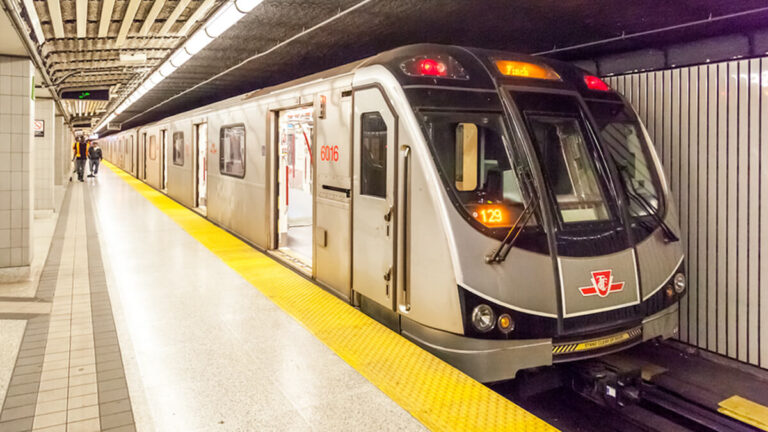
Toronto Police neighbourhood community officers work alongside the entire TTC team to add another layer of safety and help to stop crime.
By Staff Writer — CityWorks Toronto
Transit safety has become one of the most important quality-of-life issues for Torontonians. As ridership rebounded following the pandemic, so too did concerns about safety on buses, streetcars, subway platforms and vehicles.
In response, the City of Toronto, the Toronto Transit Commission (TTC) and the Toronto Police Service (TPS) have expanded their coordinated approach — assigning neighbourhood community officers to work alongside TTC staff, special constables and fare inspectors to strengthen visibility, safety and public confidence across the system.
A Collaborative Approach to Transit Safety
Rather than relying on a single solution, Toronto’s transit safety strategy is focused on layered support. Neighbourhood community officers are being deployed as part of a broader model, complementing — not replacing — existing TTC safety personnel.
These officers, who are already familiar with local communities and problem areas, work in coordination with:
- TTC special constables
- Fare inspectors and station staff
- Transit enforcement and customer service teams
Their role emphasizes presence, early intervention and coordination — helping address concerns before they escalate.
Focused on Visibility and Prevention
Neighbourhood community officers are trained to engage directly with the public. On the TTC, that translated into a focus on high-visibility patrols, particularly during peak periods and at stations or routes where incidents or complaints had been more frequent.
Their presence helped deter criminal behaviour, supported TTC staff responding to incidents, and provided riders with a clearer sense that help was nearby when needed.
Importantly, this approach prioritized prevention and reassurance, rather than enforcement alone.
Supporting Riders and TTC Workers
Transit safety is not only about passengers — it is also about protecting TTC operators, station staff and frontline workers.
In 2024, neighbourhood community officers assisted in responding to incidents involving disorder, harassment or threats toward staff, helping ensure that TTC employees could do their jobs safely and with support.
This partnership reinforced a shared goal across city services: a transit system that is safe, respectful and reliable for everyone.
Part of a Broader Safety Strategy
The deployment of neighbourhood officers was one component of a larger transit safety plan that included:
- Increased staffing levels across TTC operations
- Enhanced coordination between city divisions and emergency services
- Continued investment in service reliability and station management
Mayor Olivia Chow consistently framed transit safety as essential to rebuilding ridership and restoring trust in public transit — especially for women, seniors and vulnerable riders who may be more sensitive to safety concerns.
Community Policing in a Transit Context
By using neighbourhood community officers — rather than relying solely on centralized enforcement — the city leveraged officers’ familiarity with local conditions, community resources and recurring issues.
This approach reflected a broader policing philosophy focused on problem-solving, visibility and relationship-building, adapted to the unique environment of Toronto’s transit system.
For riders in Scarborough, Etobicoke and other neighbourhoods where buses and subways are essential to daily life, the added presence helped reinforce a sense of shared responsibility for safety.
Progress, with Ongoing Evaluation
As with all public safety initiatives, city officials emphasized that the program would continue to be monitored and refined based on results, feedback and changing conditions.
The expanded role of neighbourhood community officers represents a tangible step toward a safer, more supportive transit experience — one built on collaboration rather than any single intervention.
For many riders, that visibility matters. Because feeling safe on transit isn’t just about statistics — it’s about confidence, consistency and knowing help is close at hand.